





 Release time:2026.07.21
 Read volume:399
With supernodes integrating dozens or even hundreds of computing chips densely into a single cabinet, the power consumption record per cabinet keeps being refreshed. Traditional air cooling has hit a physical ceiling, and thermal management has become the core bottleneck restricting the large-scale deployment of supernodes. Against the industry consensus that liquid cooling has become the standard configuration for high-density intelligent computing, Far East Electric relies on self-developed full-stack liquid cooling solutions to deliver reliable thermal dissipation support for stable and efficient operation of AI supernodes, helping the computing power industry break thermal density constraints and unlock higher computing value.
The rapid evolution of AI supernodes has brought unprecedented multi-dimensional challenges to cooling systems. Different from the distributed deployment mode of traditional servers, supernodes realize clustered computing power through high-density card stacking and high-speed interconnection architectures. The power consumption of a single cabinet has jumped from the hundred-kilowatt level to several hundred kilowatts, while the power consumption of a single computing chip has exceeded the 2000W threshold. The chip heat density far surpasses the physical limit of air cooling, directly affecting the efficiency and stability of long-cycle training of large models. Meanwhile, the system-level characteristics of supernodes raise higher requirements for the coordination of cooling solutions. At present, the industry generally faces fragmented supply of components such as cold plates, CDUs and pipelines. Inconsistent interface standards of products from different manufacturers not only increase the deployment difficulty and cost of supernodes, but also bring numerous hidden dangers to subsequent liquid leakage control, operation and maintenance inspection. The industry is in urgent need of integrated liquid cooling solutions adapted to supernode architectures.
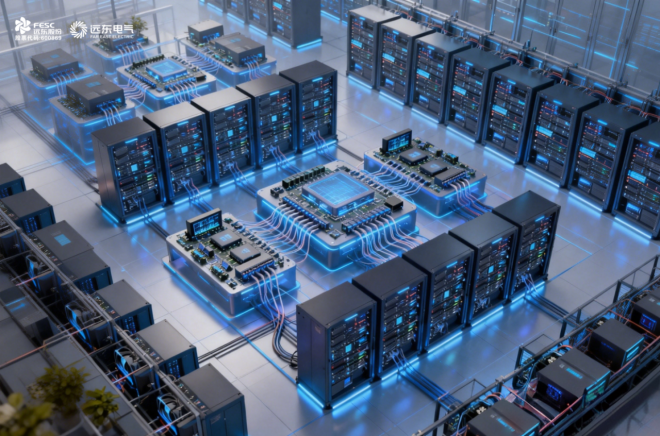
To meet the new cooling demands of the supernode era, Far East Electric innovatively launches an integrated solution of "bionic manifold micro-channel cold plate + liquid metal TIM composite material", achieving technological breakthroughs in two core dimensions of structural design and interface materials to precisely match the heat dissipation demands of high-density computing power. Drawing on the hierarchical distribution logic of blood vessels and leaf veins in nature, multi-stage tapered uniform flow channels and local redevelopment structures are constructed to realize uniform shunting of cooling liquid at the bottom of chips. This greatly enhances convective heat transfer capacity, effectively reduces system pressure drop and pump power consumption. Combined with high-thermal-conductivity liquid metal interface composite materials to form a collaborative embedded thermal channel, the solution fundamentally solves industry pain points including high interface thermal resistance and large in-plane temperature difference. It can accurately extract heat from high-heat areas of chips and suppress hotspot failure and performance degradation.
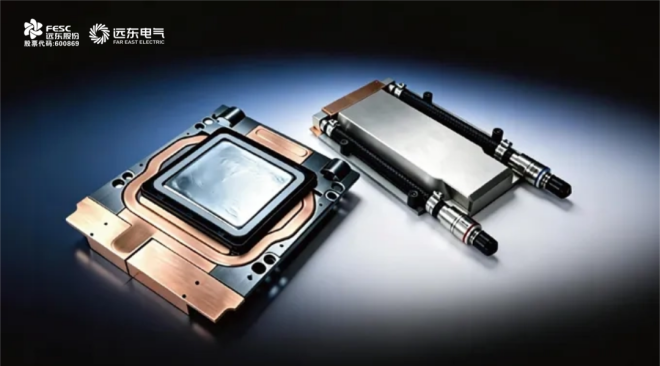
Compared with the mainstream single-phase cold plates in the industry with a maximum heat dissipation capacity of 1000W, Far East Electric doubles performance with lower pump energy consumption. Under a 2300W load, it can lower the temperature by over 40℃ versus traditional cooling schemes, achieving a groundbreaking improvement in energy efficiency per unit power. It fully meets the cooling requirements of new-generation high-power computing chips, supporting customized development for mainstream architecture platforms such as Hopper and Blackwell as well as domestic supernodes. To match the system-level deployment needs of supernodes, Far East Electric has also built a full-stack liquid cooling product matrix covering chip-level thermal interface materials and cabinet-to-liquid CDUs. The products can be directly integrated inside supernode cabinets to realize collaborative optimization between cooling systems and computing systems. The integrated complete set of solutions supports one-stop delivery, effectively resolving the long-standing fragmentation problem in the industry. In addition, it can deeply coordinate with Far East’s high-speed copper cables, optical fiber interconnection, energy storage backup power and other products to form an all-scenario AIDC solution featuring "high-speed interconnection + efficient heat dissipation + reliable power supply", providing comprehensive support for large-scale deployment of supernodes.
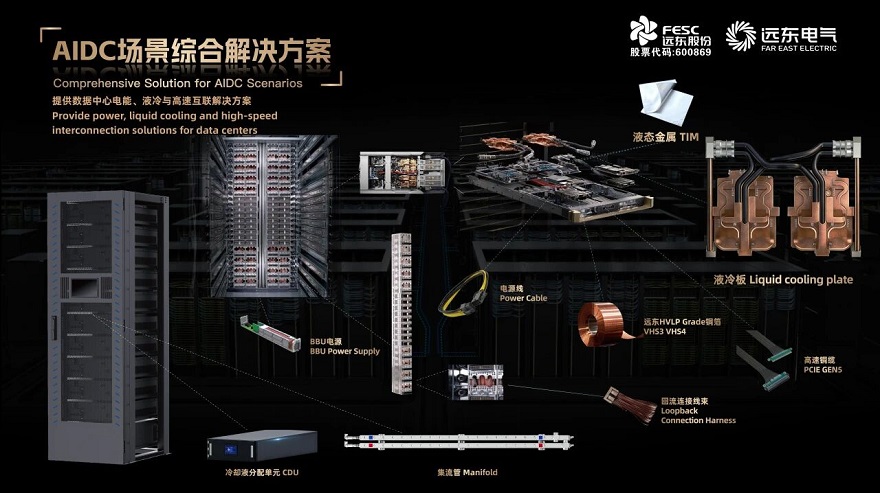
In the future, Far East Electric will continue to deepen technological iteration in the field of liquid cooling thermal management, continuously optimize product performance around the higher-power computing demands of supernodes, and expand the application scope of liquid cooling technology across cross-sector scenarios including industrial high-power equipment and energy storage systems. With efficient and reliable cooling technology, we will consolidate the operation foundation for supernode computing power and provide solid infrastructure support for high-quality development of the AI industry.
 Back to List