





 Release time:2026.03.17
 Read volume:485
Far East Electric's vehicle-mounted Ethernet cable harness supports high-speed transmission rates from 100 Mbps to 10 Gbps, among which the BroadR-Reach standard can reach 1 Gbps—tens to hundreds of times faster than traditional CAN buses. It can easily meet the high-frequency data transmission requirements of scenarios such as ADAS sensors, intelligent cockpits, and vehicle networking.
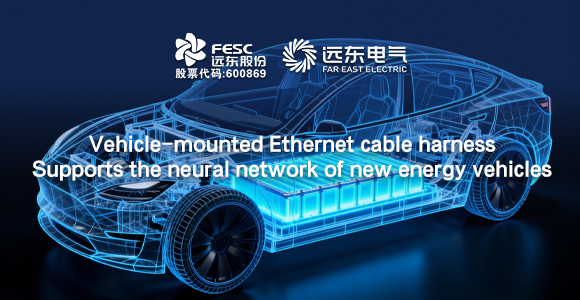
As new energy vehicles undergo a profound leap from "electrification" to "intelligentization and connectivity", functions such as ADAS (Advanced Driver Assistance Systems), intelligent cockpits, and vehicle-road coordination have become standard configurations, putting vehicle-mounted data transmission to the test of "explosive growth". The bandwidth limitations of traditional CAN buses have become increasingly prominent. Meanwhile, with the continuous upgrading of intelligent driving levels, the number of sensors such as cameras and radars equipped on a single new energy vehicle has increased significantly. Scenarios such as high-precision map updates, real-time road condition transmission, and multi-screen interaction impose extremely high requirements on the bandwidth and latency of data transmission. Leveraging its core advantages of high bandwidth and low latency, vehicle-mounted Ethernet has become the core backbone of the new-generation automotive electronic architecture, supporting the "neural network" of intelligent mobility.
With over 40 years of deep cultivation in the power energy sector, Far East has closely followed the national strategy for the high-quality development of new energy. In recent years, it has even adopted an "ALL IN AI" approach, establishing "electric energy + computing power + AI" as its core strategy and conducting in-depth layout in the new energy vehicle field. Due to the compact space inside the vehicle, equipment such as motors and batteries generate strong electromagnetic interference. Meanwhile, vibrations and extreme temperature variations during vehicle operation place extremely high demands on the durability of cables. Far East's Ethernet cable harness adopts a design of thin-diameter wires combined with lightweight shielding layers (such as aluminum foil or braided shielding), effectively resisting electromagnetic interference (EMI) inside the vehicle and avoiding intelligent driving misjudgments caused by signal interference. Complying with automotive-grade standards, it also boasts excellent temperature resistance, vibration resistance, and wear resistance. Rigorous testing has verified its stable and reliable performance during long-term use, making it suitable for the complex working conditions of vehicles.
Meanwhile, addressing the core demands of new energy vehicles for "weight reduction, cost reduction, and efficiency improvement", Far East Electric's Ethernet cable harness can reduce weight by 30% to 50% and costs by 30% compared with traditional harness solutions. At the same time, it supports transmission rates from 100 Mbps to 10 Gbps, fully meeting the large bandwidth requirements of ADAS, in-vehicle infotainment, autonomous driving, and other applications, and significantly enhancing real-time data processing capabilities. Additionally, replacing multiple harnesses with a single twisted pair reduces the number of connectors and simplifies the overall vehicle wiring structure. This not only lowers the wiring costs for automakers but also reduces overall vehicle energy consumption, indirectly extending the driving range, achieving a dual breakthrough in "lightweighting" and "economics".
In the future, Far East Electric will continue to leverage its technological advantages and innovation capabilities, empowering global automakers with high-performance product solutions. Focusing on technological iteration and product optimization, it will collaborate with upstream and downstream partners to drive the high-quality development of the industry and provide more efficient, safe, and reliable solutions for the new energy vehicle sector.
 Back to List